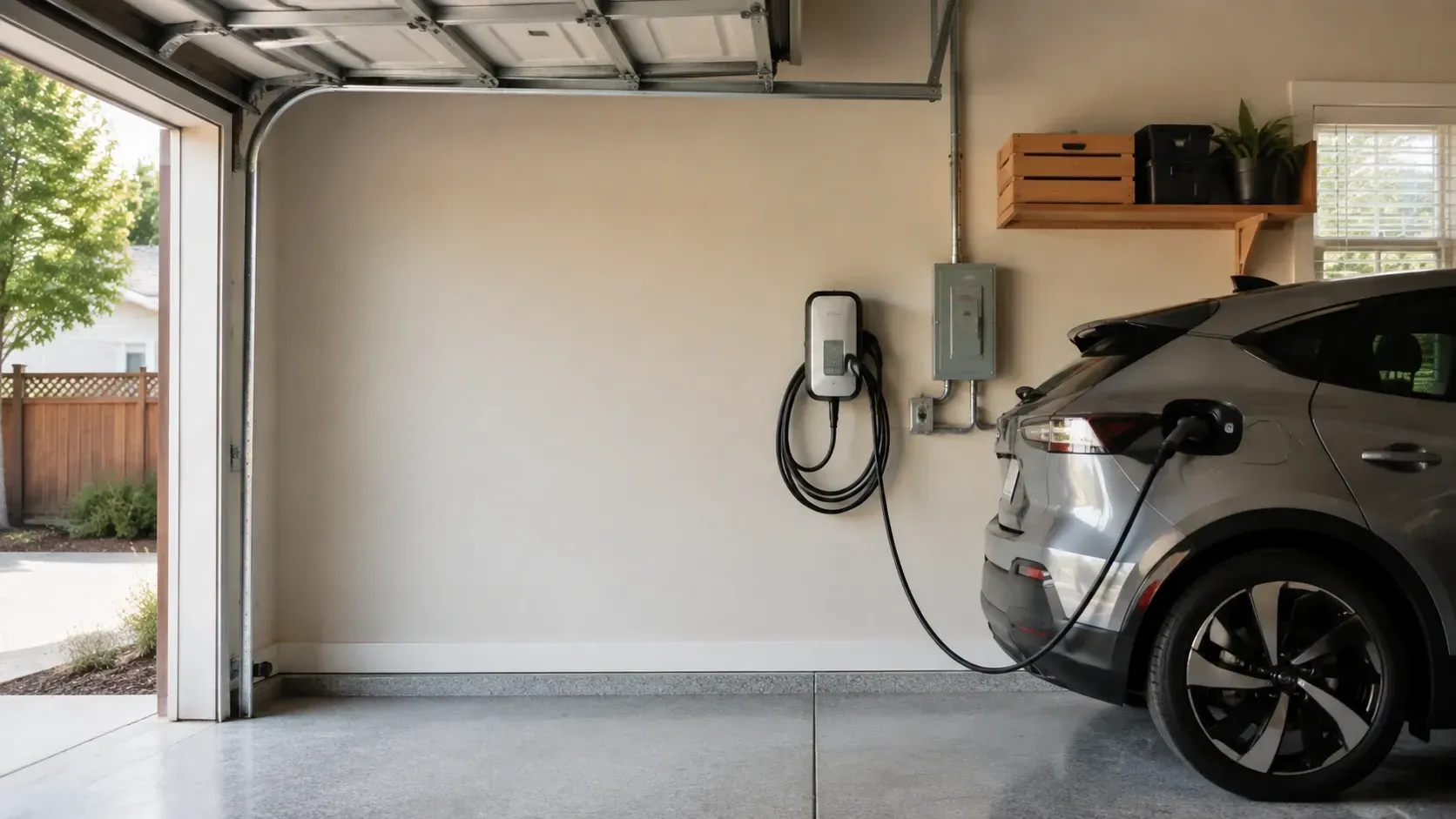
Level 1 vs Level 2 EV Charging: Which Is Right for Your Home?
Compare Home Charging Options Based on How You Actually Use Your EV
Choosing between Level 1 and Level 2 home EV charging is not simply a question of which option charges faster. The better choice depends on how far the vehicle is typically driven, how long it remains parked at home, its charging capability, and how much charging flexibility the household needs.
Level 1 charging uses a 120-volt source and provides a relatively modest charging rate, while Level 2 charging uses a higher-voltage dedicated charging setup and can provide substantially more power. That difference matters, but maximum charging speed does not necessarily determine which option is most practical for a particular homeowner.
Most drivers do not arrive home each evening with an empty EV battery that needs to be completely recharged by morning. A more useful question is whether the home charging setup can reliably replace the energy normally used between charging opportunities. Looking at daily driving and available charging time can help Sacramento homeowners determine whether Level 1 is sufficient or whether Level 2 provides worthwhile additional capacity and convenience.
Understand the Basic Difference Between Level 1 and Level 2 Charging
Level 1 and Level 2 charging both use alternating current (AC) electricity to charge an EV at home, but they operate at different voltage and power levels. Level 1 charging uses a 120-volt source, while Level 2 charging typically uses a 208- or 240-volt electrical circuit and can provide substantially more charging power.
Level 1 charging commonly uses charging equipment connected to an appropriate 120-volt receptacle. Because the available power is relatively limited, energy is added to the battery gradually. That slower charging rate can still be practical when the vehicle is parked for long periods and the homeowner does not need to replace a large amount of energy each day.
Level 2 charging requires a higher-voltage electrical supply and can be installed using either compatible plug-in equipment or a hardwired charger, depending on the charging equipment and installation. Level 2 also covers a wide range of charging outputs, so choosing Level 2 does not automatically mean installing the highest-powered charger or largest circuit available.
In both cases, the vehicle's onboard charger helps determine how much AC charging power the EV can actually accept. Charging equipment may be capable of supplying more power than a particular vehicle can use, so the charger's maximum rating does not necessarily represent the charging rate the homeowner will experience.
The practical difference between Level 1 and Level 2 is therefore not simply that one is slow and the other is fast. Level 1 provides a lower rate of energy replacement that may be sufficient for some households, while Level 2 provides greater charging capacity and flexibility for households that need to replace more energy in the time the vehicle is available to charge.
Start With How Much You Normally Drive Each Day
One of the most useful factors when choosing between Level 1 and Level 2 charging is how much the EV is normally driven each day. A homeowner with a relatively short daily commute has very different home charging requirements from someone who routinely drives long distances or makes multiple trips throughout the day.
It is easy to focus on how long a charger would take to bring the battery from nearly empty to full, but that may not represent normal home charging. Most homeowners do not use the vehicle's entire battery capacity every day. Instead, home charging usually replaces the portion of the battery that was consumed during the day's driving.
For someone with modest daily mileage, Level 1 charging may be able to replace that energy during the hours the vehicle is parked at home. The battery does not necessarily need to return to a full charge immediately; the important question is whether the charging rate can consistently keep up with the household's normal vehicle use.
Greater daily mileage changes that calculation. A longer commute, frequent errands, business driving, or other regular travel can create a larger amount of energy to replace each day. Level 2 charging can restore that energy more quickly and provide additional capacity for days when the vehicle is driven farther than usual.
Looking at several weeks of typical driving can provide a better picture than planning around the longest trip the vehicle might occasionally make. Understanding the household's normal daily mileage provides a practical starting point for deciding whether Level 1 can keep pace or whether the additional charging capacity of Level 2 would be useful.
Consider How Long the EV Is Parked at Home
The amount of time an EV normally remains parked at home can be just as important as daily driving distance when choosing between Level 1 and Level 2 charging. A vehicle that arrives home in the early evening and remains parked until the following morning may have many hours available to replenish the energy used during the day.
That extended charging window can make Level 1 more practical than its relatively low charging rate might initially suggest. If the vehicle needs only a modest amount of energy replaced and remains connected for much of the evening and overnight, Level 1 may have enough time to keep pace with the household's normal driving.
A shorter or less predictable charging window can make Level 2 more useful. Someone who arrives home late, leaves early, works irregular hours, or frequently uses the vehicle again during the evening may have fewer hours available for charging. Being able to replace energy more quickly provides greater flexibility when the vehicle cannot remain connected for long periods.
Charging opportunities do not have to occur only overnight. A vehicle may remain home for extended periods during weekends, work-from-home days, or days when another vehicle is used. Those additional hours can help a lower-powered charging setup keep the battery at a useful level even if it does not replace every day's energy immediately.
Considering both energy used and time available to replace it provides a more realistic way to compare Level 1 and Level 2 than charging speed alone. A lower charging rate paired with a long parking window may work very well, while a household with greater driving demands and shorter charging windows may benefit substantially from Level 2.
Understand Where Level 1 Charging Can Work Well
Level 1 charging can be a practical home charging solution when the vehicle's normal energy use is modest and there is plenty of time available for charging. Although it provides considerably less power than Level 2, charging speed alone does not determine whether it can meet a household's needs.
A homeowner with a relatively short commute or limited daily driving may be able to replace the energy used each day during the evening and overnight. Someone who works from home, is retired, or simply does not drive every day may have even longer charging windows, allowing Level 1 to keep the battery at a useful charge without requiring faster equipment.
Level 1 can also work particularly well for some plug-in hybrid electric vehicles, which generally have smaller batteries and shorter electric-only driving ranges than fully electric vehicles. When the amount of energy that needs to be replaced is relatively small, the lower charging rate may still be sufficient to restore the vehicle's usable electric range while it is parked.
Another advantage is that Level 1 may allow a homeowner to begin charging without immediately installing a Level 2 charging circuit. However, the 120-volt circuit and receptacle still need to be appropriate for sustained EV charging. An available household receptacle should not automatically be assumed suitable simply because the vehicle's charging equipment can plug into it.
Level 1 charging can also require more consistent charging habits. Because energy is added relatively slowly, homeowners may need to plug in whenever the vehicle returns home rather than waiting until the battery becomes low. Missing an evening or other long charging opportunity can leave less time to replace the energy used, particularly when the vehicle will be driven again the following day.
Level 1 works best when its charging rate can consistently keep pace with the household's actual vehicle use and the homeowner is comfortable maintaining regular charging habits. If the vehicle is normally plugged in when it returns home, is ready when needed, and the battery is not gradually falling behind the household's driving demands, there may be little practical reason to install greater charging capacity solely because Level 2 is faster.
Understand When Level 2 Provides More Flexibility
Level 2 charging becomes more valuable when a household regularly needs to replace more energy or has less time available for charging. Its higher charging capacity can make it easier to keep the vehicle ready without depending on a long, uninterrupted charging window every time the EV returns home.
Homeowners with longer commutes, substantial daily mileage, or frequent evening travel may benefit from being able to restore energy more quickly. Level 2 can also be useful when driving varies considerably from one day to the next, because a higher charging rate provides additional capacity to recover after an unusually busy driving day.
That flexibility can matter even when Level 1 would be sufficient for the household's average daily mileage. An unexpected trip, arriving home with a lower battery level than usual, or needing the vehicle again later the same day can reduce the amount of time available for charging. Level 2 provides greater ability to add useful energy during those shorter charging opportunities.
Level 2 may also make sense for households that simply want more charging margin. Rather than routinely depending on most of the available overnight period to replace the day's energy, the vehicle may be able to complete its scheduled charging earlier. How much additional flexibility this provides depends on the vehicle's charging capability and the Level 2 charging output selected.
The value of Level 2 is therefore not just that it can charge an EV faster. Its greater benefit for many homeowners is flexibility when driving distance, charging time, or daily schedules change. If Level 1 consistently keeps the vehicle ready, additional charging capacity may provide limited practical benefit; if the household regularly needs more charging margin, Level 2 can become the more convenient choice.
Compare the Electrical Requirements
Level 1 and Level 2 charging place different demands on a home's electrical system. Level 1 operates at 120 volts, while residential Level 2 charging typically uses a 240-volt circuit and can provide substantially more power. Those differences affect both the available charging rate and the electrical work that may be needed.
Level 1 charging may appear straightforward because 120-volt receptacles are common in residential garages. However, the presence of a receptacle does not automatically mean the circuit is appropriate for sustained EV charging. The circuit, receptacle, wiring, other loads on the circuit, and charging equipment should all be considered when determining whether an existing 120-volt source is suitable.
Level 2 generally requires a dedicated 240-volt circuit sized for the charging equipment and intended output. Depending on the equipment, the charger may be hardwired or connected through an appropriate receptacle. The electrical panel must also have the breaker space and available electrical capacity needed to support the planned charging load.
It is important to remember that Level 2 is not a single charging power level. Different chargers and circuits can support different outputs, and a homeowner does not necessarily need the highest Level 2 charging rate available. A lower-output Level 2 installation may still provide substantially more charging capacity than Level 1 while placing less additional demand on the home's electrical system.
Available electrical capacity can therefore influence the Level 1 versus Level 2 decision, but it should not be considered in isolation. If a home cannot readily support a high-output Level 2 installation, possible alternatives may include selecting a lower charging output or, where appropriate, considering load-management options rather than assuming the only choices are maximum-power Level 2 or no Level 2 at all.
The electrical comparison ultimately comes back to the household's charging needs. Level 1 requires less charging power but provides a lower rate of energy replacement, while Level 2 requires a more substantial electrical supply in exchange for greater charging capacity and flexibility. Evaluating what the vehicle actually needs alongside what the home can reasonably support can help determine the appropriate balance.
Consider Convenience Beyond Charging Speed
Charging speed is only one part of the Level 1 versus Level 2 decision. A home charging setup should also fit naturally into the household's routine, allowing the vehicle to be connected when convenient and ready when needed without requiring the homeowner to regularly think about whether enough charging time remains.
Level 1 can require more attention to charging habits because time is a larger part of making the system work. A homeowner who consistently plugs in after driving may find Level 1 effortless, while someone who frequently forgets to connect the vehicle may find the slower rate leaves less opportunity to recover before the next trip. Level 2's greater charging capacity can provide more margin when a charging opportunity is missed.
Homeowners who use portable charging equipment for Level 1 charging should also consider whether they want that equipment to remain available in the vehicle. If the same portable charger is intended for charging away from home, it may need to be disconnected, stored, and returned to the vehicle after home charging. Dedicated home charging equipment can eliminate that routine and allow the portable charger to remain with the vehicle.
Level 2 can provide additional convenience by creating more flexibility around when charging occurs. Because more energy can be added during a shorter period, homeowners may have greater freedom to schedule charging during preferred hours, recover from an unusually long driving day, or prepare the vehicle for another trip without needing as much time connected.
Charging equipment features can also affect convenience independently of charging level. Depending on the vehicle and charger, features such as scheduled charging, energy monitoring, Wi-Fi connectivity, mobile-app controls, and charging-history information may help homeowners manage when and how the vehicle charges. Equipment should therefore be compared based on useful features as well as maximum charging output.
The most convenient charging setup is ultimately the one that requires the least unnecessary attention while reliably keeping the vehicle ready. For some households, Level 1 can accomplish that perfectly well. For others, the additional charging margin and flexibility provided by Level 2 can make home charging easier to fit around changing schedules and driving needs.
Think About How Your Charging Needs May Change
The charging setup that works well today may not always match the household's needs, so it is worth considering changes that can reasonably be anticipated. A different commute, another EV, a change in work schedule, or replacing the current vehicle can all affect how much energy needs to be replaced at home and how much time is available for charging.
A homeowner using Level 1 successfully today may eventually find that increased daily driving makes Level 2 more practical. Conversely, changing to remote work, retiring, or reducing a commute could decrease daily charging needs. Home charging requirements can change in either direction rather than automatically increasing over time.
The vehicle itself can also change the equation. A future EV may have different efficiency, battery capacity, or AC charging capabilities than the vehicle currently in the garage. If another EV is added to the household, the question may expand beyond Level 1 versus Level 2 for one vehicle to how available charging capacity should be shared between multiple vehicles.
Reasonable future planning does not mean every homeowner needs to install the largest circuit or highest-output charger available today. Adding electrical capacity that is unlikely to be used can increase the scope of the installation without providing a meaningful everyday benefit. The better approach is to consider changes that are genuinely foreseeable and determine whether they should influence the current project.
Homeowners also do not necessarily have to make a permanent Level 1 versus Level 2 decision at the beginning of EV ownership. Level 1 may provide a practical way to start home charging, and Level 2 can be considered later if experience shows that additional charging capacity or flexibility would provide a meaningful benefit.
Choose the Charging Level That Fits Your Household
Choosing between Level 1 and Level 2 charging ultimately comes down to whether the charging setup can reliably keep the vehicle ready for the way the household actually uses it. Daily driving distance, available charging time, vehicle capability, electrical requirements, and desired convenience all matter more than simply choosing the option with the highest charging speed.
Level 1 may be the right choice when daily driving is modest, the vehicle remains parked for long periods, and the available charging time consistently replaces the energy being used. If the EV is normally ready when needed and the homeowner is not regularly adjusting driving or charging habits around the slower charging rate, Level 1 may already be accomplishing everything required.
Level 2 becomes more compelling when daily mileage is greater, charging windows are shorter, schedules are unpredictable, or the homeowner wants additional charging margin between trips. The appropriate Level 2 installation does not necessarily need to provide the charger's maximum possible output; it only needs to provide enough capacity to meet the household's charging needs while working appropriately with the home's electrical system.
For homeowners who are uncertain, actual experience can sometimes provide the best answer. Starting with Level 1 when an appropriate charging source is available can show whether it comfortably keeps pace with normal driving. If the vehicle regularly falls behind, charging requires too much planning, or additional flexibility would clearly improve everyday use, those are practical reasons to consider Level 2.
There is no single home charging level that is right for every EV owner. The better choice is the one that provides sufficient charging capacity without adding unnecessary complexity or electrical demand. When the vehicle is reliably ready when needed and charging fits naturally into the household's routine, the home charging setup is doing its job.
Conclusion
Choosing between Level 1 and Level 2 home charging does not have to begin with which option charges faster. The more useful starting point is understanding how much the vehicle is normally driven, how much energy needs to be replaced, how long the EV is typically parked at home, and whether the homeowner's normal charging habits make good use of that available time.
Level 1 can be a practical solution when daily driving is modest, long charging windows are available, and the vehicle is plugged in consistently enough for the lower charging rate to keep pace. Level 2 provides greater charging capacity and flexibility when driving demands are higher, charging opportunities are shorter or less predictable, or the homeowner wants more margin to recover when a charging opportunity is missed.
The right choice is the charging setup that works comfortably with the vehicle, the home's electrical system, and the household's everyday routine. Sacramento homeowners do not necessarily need the fastest charging option available—they need enough charging capacity, time, and convenience to reliably have the vehicle ready when it is needed.
Is Level 1 charging enough for daily EV driving?
It can be. Level 1 may work well when daily mileage is modest, the vehicle remains parked for long periods, and the homeowner plugs in consistently enough for the charging rate to keep pace with normal driving.
How do I know if I need Level 2 charging at home?
Consider how much you normally drive and how much time the EV is available to charge. If Level 1 cannot consistently replace the energy you use, or you want more flexibility for shorter charging windows and unexpected driving, Level 2 may be more practical.
Does Level 1 charging require a special electrical outlet?
Level 1 uses a 120-volt electrical source, but an available household receptacle should not automatically be assumed suitable for sustained EV charging. The circuit, receptacle, wiring, other loads on the circuit, and charging equipment should be appropriate for the intended use.
Do I need the highest-powered Level 2 charger available?
No. Level 2 covers a range of charging outputs, and the appropriate amount of power depends on the vehicle, household charging needs, and available electrical capacity. A moderate Level 2 configuration may provide all the charging flexibility a homeowner needs.
Can I start with Level 1 and install Level 2 later?
Yes. Level 1 can provide a practical way to begin home charging when an appropriate electrical source is available. If experience shows that the vehicle regularly falls behind or charging requires too much planning, Level 2 can be considered later.
Should I keep my portable EV charging cable in the vehicle?
That depends on how the homeowner intends to use it. If the same portable charger is used for Level 1 charging at home and is also intended for charging away from home, it may need to be disconnected and returned to the vehicle after charging; dedicated home charging equipment can allow the portable charger to remain with the EV.
Contact Us
Contact Us - Resources Level 2 Guide
Not sure whether Level 1 or Level 2 charging is right for your Sacramento home?
Your daily driving, available charging time, vehicle, electrical system, and charging habits can all affect the answer. Call to discuss your project and the home charging option that may best fit your needs.