EV Charger Installation Sacramento
Smart EV Chargers: Wi-Fi, Scheduling and Energy Management
A smart EV charger performs the same essential function as any properly sized home charging station: it safely delivers electricity to your vehicle. What makes it “smart” is its ability to connect to Wi-Fi or another network and provide additional controls through a mobile app or online account.
Depending on the charger, these features may include scheduling, remote start and stop, charging notifications, energy-use reports, access controls, and coordination with other electrical loads in your home.
Smart features can make home charging more convenient, help manage electricity costs, and support more advanced energy planning—but they are not necessary for every EV owner.
What can a smart EV charger do?
Features vary by manufacturer and model, but a smart charger may allow you to:
- Schedule charging for selected hours
- Start or stop a charging session remotely
- Check whether your vehicle is actively charging
- Receive notifications when charging begins, stops, or is interrupted
- Track electricity use by day, week, month, or charging session
- Estimate charging costs
- Limit charger access
- Adjust the charger’s maximum power output
- Download charging records
- Integrate with some solar, battery, utility, or home-energy systems
- Install software and security updates
Some of these capabilities may already be available through your vehicle’s mobile app. Many EVs provide charging schedules, status notifications, charging limits, and remote controls without requiring a networked wall charger.
Before purchasing a smart charger, compare its features with those already included with your EV. Paying for duplicate controls may add complexity without providing much additional value.
Charging schedules and time-of-use rates
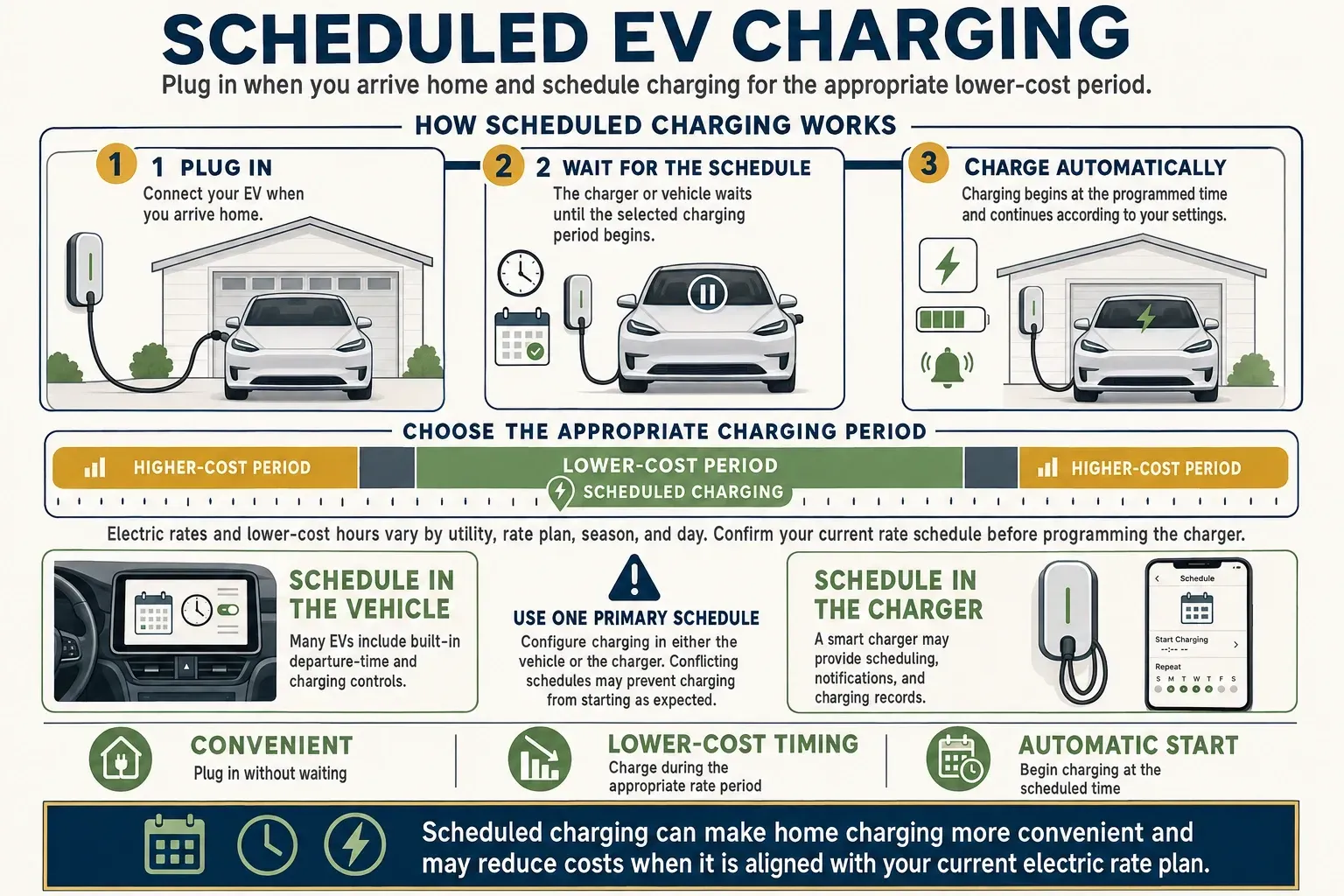
One of the most useful smart-charger features is the ability to schedule charging.
Under a time-of-use electric rate, electricity prices vary depending on when power is used. Scheduling an EV to charge during lower-cost hours may reduce charging costs while avoiding periods of heavier demand on the electrical grid.
SMUD residential EV owners can participate in its Time-of-Day rate. SMUD currently identifies weekday summer hours from 5 p.m. to 8 p.m. as the highest-cost period. Registered plug-in EV owners may also receive an additional 1.5-cent-per-kilowatt-hour discount for electricity used between midnight and 6 a.m. The vehicle must be registered with the DMV at the same service address as the SMUD account. SMUD electric-vehicle rate information
Rates, eligibility requirements, and time periods can change. Homeowners should confirm their current utility rate before programming a charger or vehicle schedule.
A typical routine might be:
- Plug in the vehicle when you arrive home.
- Program charging to begin during the appropriate lower-cost period.
- Set a departure time or desired charging limit.
- Allow the charger or vehicle to complete the session automatically.
This can make charging nearly effortless. However, scheduling should generally be configured in either the charger or the vehicle—not independently in both. Conflicting schedules can prevent charging from beginning when expected.
Monitoring energy use and charging costs
A connected charger can help you understand how much electricity your vehicle uses at home. Depending on the model, its app may display:
- Energy delivered in kilowatt-hours
- Charging duration
- Estimated charging cost
- Charging history
- Energy use by individual session
- Charging patterns over time
This information can be useful when comparing electric rate plans, tracking household energy use, or separating business-related vehicle charging from personal use.
Cost figures shown by a charger are usually estimates. Their accuracy depends on whether the correct utility rate and time-of-use periods have been entered into the app. The utility meter and electric bill remain the authoritative record of electricity consumption and charges.
Smart charging and home energy management
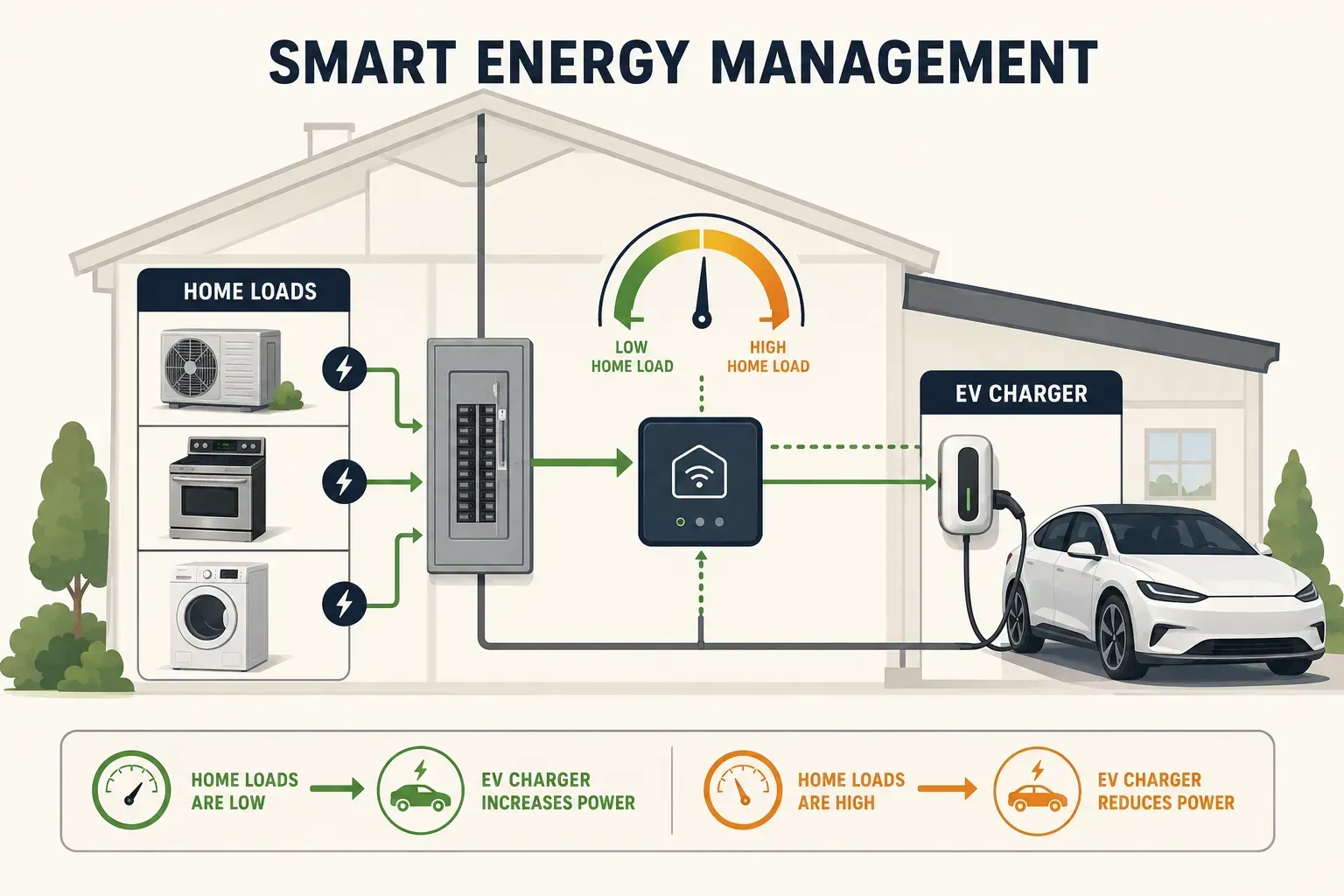
Some chargers go beyond basic scheduling and reporting. They can coordinate EV charging with the electrical capacity of the home.
This is often called load management, dynamic load balancing, or energy management. A compatible system monitors how much electricity the home is using and adjusts EV charging so the combined demand remains within a defined limit.
For example, the charger might temporarily reduce its output while an electric range, clothes dryer, air conditioner, or heat pump is operating. It can then increase charging power when other household demand falls.
In the right application, energy management may:
- Reduce the likelihood of exceeding the home’s available electrical capacity
- Allow charging power to adjust as other loads change
- Coordinate two or more EV chargers
- Support homes adding batteries, solar, heat pumps, or other electric equipment
- In some cases, provide an alternative to a larger electrical-service upgrade
Energy management does not automatically eliminate the need for a panel or service upgrade. The home’s electrical system, proposed charger, equipment compatibility, local requirements, and permitted design must all be evaluated before that conclusion can be made
Managing two EVs
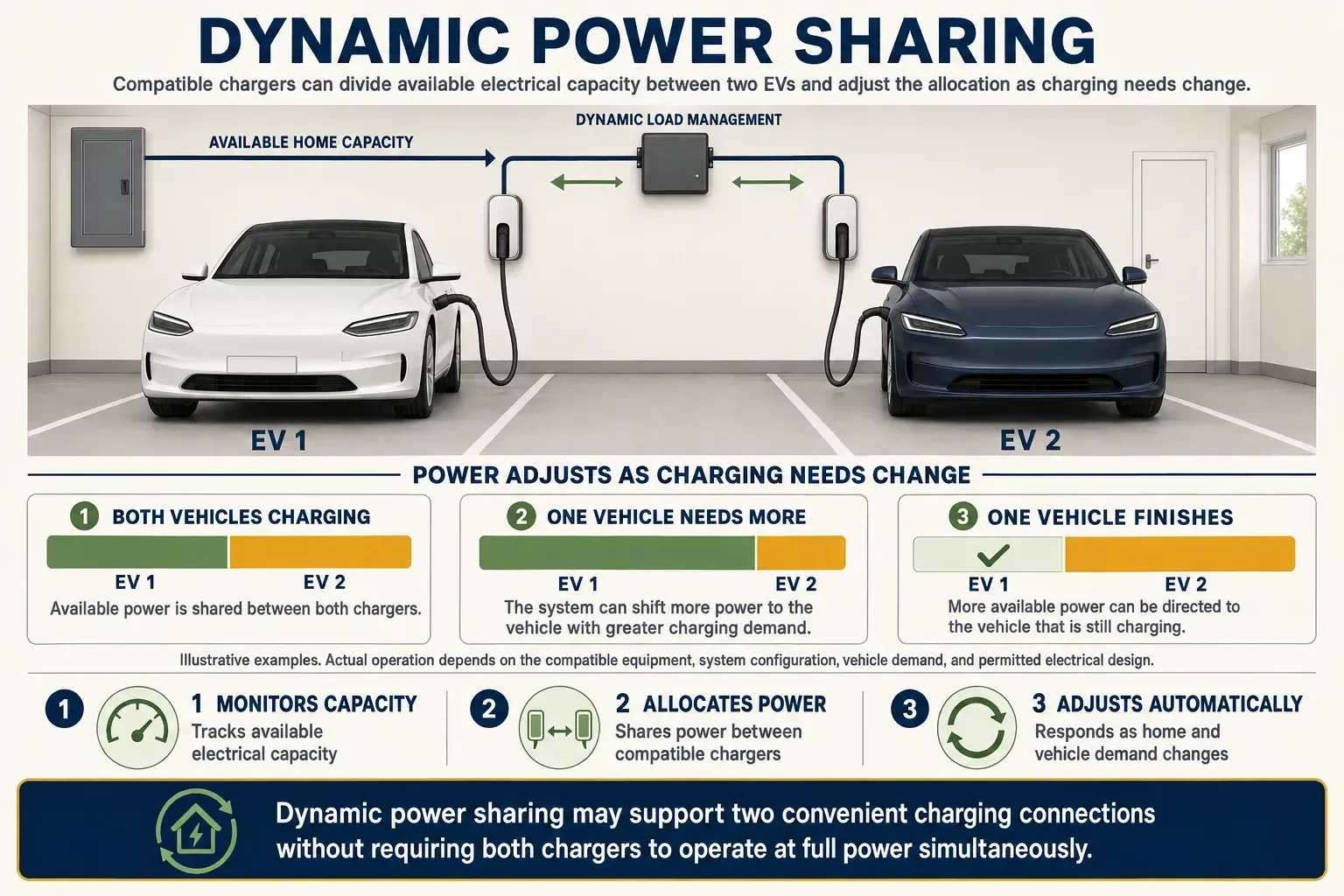
A home with two electric vehicles does not always require two chargers operating at full power simultaneously.
Compatible chargers may share an available circuit or power allocation between two vehicles. Depending on the system, power can be divided between them or directed to one vehicle before charging the other.
This can be especially useful when:
- Both vehicles remain parked overnight
- Each vehicle travels a moderate number of miles per day
- The electrical panel has limited spare capacity
- The homeowners want the convenience of two charging connections
The appropriate arrangement depends on the vehicles, daily driving needs, charger capabilities, available electrical capacity, and whether the equipment supports coordinated charging.
How dependent is a smart charger on Wi-Fi?
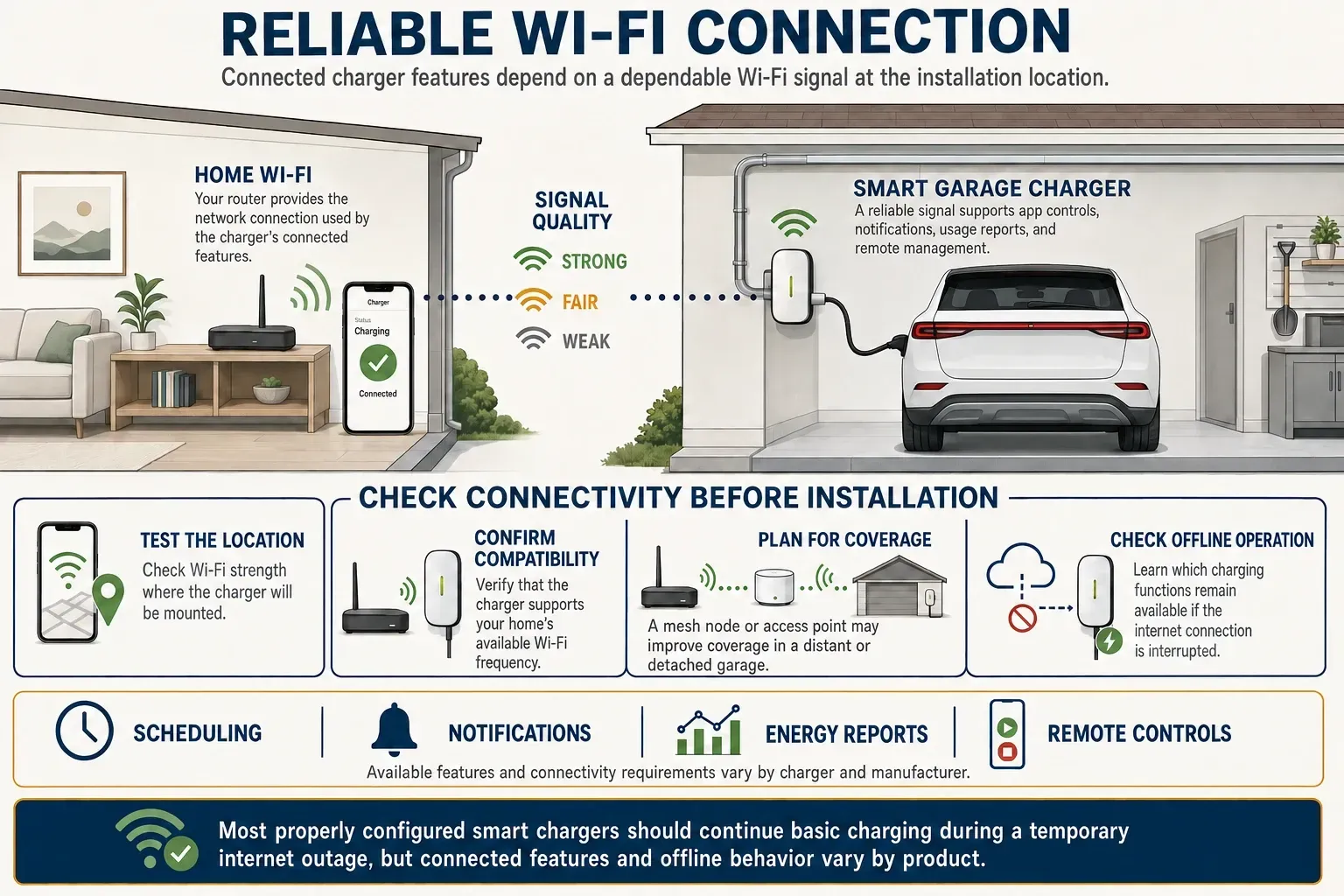
A smart charger normally needs a reliable Wi-Fi connection to provide app controls, notifications, usage reports, and remote management.
Most properly configured chargers should still provide basic vehicle charging if the internet connection is temporarily unavailable, but features and offline behavior vary by product. Some chargers may retain an existing schedule locally, while others may lose remote controls or reporting until connectivity returns.
Before selecting a charger, consider:
- Wi-Fi signal strength at the installation location
- Whether the charger supports the available Wi-Fi frequency
- How it operates during an internet outage
- Whether basic charging requires an active account or cloud service
- The manufacturer’s history of software support
- Warranty and technical-support availability
A detached garage or an exterior parking area may need improved Wi-Fi coverage for connected features to work reliably.
Privacy, accounts and long-term support
A connected charger may collect information such as charging times, energy consumption, device status, and account activity. Homeowners should review the manufacturer’s privacy and data policies before creating an account.
It is also worth considering what happens if:
- The manufacturer discontinues the product
- Its cloud service changes or shuts down
- The home is sold
- Account ownership needs to be transferred
- The charger stops receiving security updates
For long-term reliability, basic charging should not depend unnecessarily on a phone, subscription, or continuously available cloud service.
Is a smart charger better than a standard charger
Not automatically. A high-quality non-networked charger may be the better choice for someone who values simplicity and already has adequate scheduling controls in the vehicle.
A smart charger is more compelling when the homeowner wants:
- Remote monitoring and notifications
- Detailed charging and energy records
- Utility-rate scheduling
- Access control for a shared or outdoor charger
- Coordination between multiple EVs
- Integration with a home-energy system
- Dynamic management of limited electrical capacity
The best charger is not necessarily the one with the longest feature list. It is the one that is compatible with the vehicle, electrical system, installation location, household routines, and long-term plans.
Choosing a smart charger for your Sacramento home
Before buying a charger, consider these questions:
- Does your EV already provide the controls you need?
- Do you want plug-in equipment or a hardwired installation?
- Will the charger be installed indoors or outdoors?
- Is dependable Wi-Fi available at that location?
- Do you want energy reports or only scheduled charging?
- Will the home eventually charge a second EV?
- Are solar panels, battery storage, or other electrical upgrades planned?
- Does the charger support compatible load-management equipment?
- Is the equipment safety-certified and suitable for the installation location?
- Will its charging output comply with any rebate program you intend to use?
- Who will provide warranty and technical support?
- What happens to basic charging if the app or cloud service becomes unavailable?
It is also wise to have the home’s electrical capacity assessed before purchasing equipment. That helps ensure the charger’s circuit requirements and energy-management features are appropriate for the property.
The rebate question is particularly relevant in Sacramento because SMUD’s current Charge@Home program imposes equipment and output requirements. A feature-rich charger is not necessarily rebate-eligible.
Contact Us
Contact Us - sacramento-smart-ev-chargers
Need Help Choosing and Installing a Smart EV Charger?
Smart features are most valuable when the charger is selected as part of the complete installation—not treated as a separate gadget after the electrical decisions have already been made.
We can help evaluate your electrical panel, charging requirements, proposed charger location, Wi-Fi coverage, utility-rate goals, and future plans. That allows you to select a smart charging solution that fits your Sacramento-area home without paying for features you are unlikely to use.